
Otium Analytics
Otium Analytics is an advanced decision support platform developed from more than 20 years of research, project delivery and proprietary modelling across the sport, recreation and community infrastructure sectors. By combining GIS mapping, demographic analysis, participation forecasting, and spatial planning tools, it provides governments and sporting organisations with a robust evidence base to plan, prioritise, and invest with confidence. Its interactive environment allows stakeholders to test assumptions, compare scenarios and explore the impacts of different investment decisions in real time.
Using sophisticated forecasting and evaluation models, Otium Analytics delivers actionable insights into future community demand, infrastructure requirements, operational sustainability and investment performance. The platform quantifies the potential economic, social, and financial returns of proposed projects through participation modelling, market penetration analysis, staffing and operational assessments, and investment appraisal metrics such as Net Present Value and Benefit-Cost Ratio. By transforming complex data into clear, evidence-based outcomes, Otium Analytics helps organisations make better decisions, strengthen funding applications and maximise the value delivered to communities.
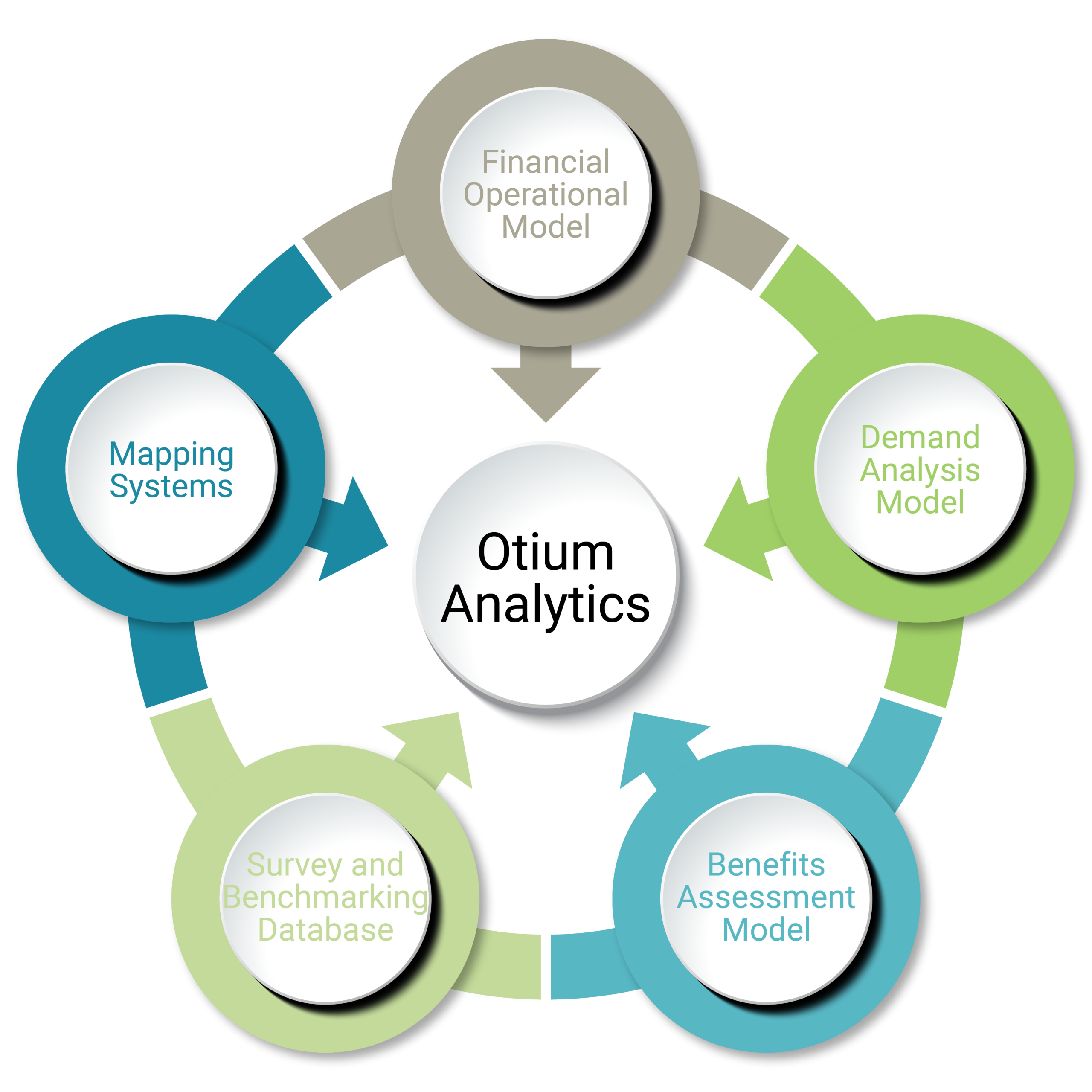
There are three interactive models utilised:

Demand Analysis Model
Demand Analysis Model
The Demand Analysis Model forecasts future participation, facility demand and land requirements to support evidence-based planning and investment decisions. It analyses participation by age group and activity type, assesses facility capacity and utilisation, and identifies future infrastructure needs, service gaps and investment priorities.

Benefits Assessment Model
Benefits Assessment Model
The Benefits Assessment Model measures the economic, social and health benefits generated by facility and infrastructure investments. Using inputs from the Financial Operating Model, it quantifies impacts such as employment, community wellbeing, Net Present Value and Benefit Cost Ratio, providing a strong evidence base for business cases and funding applications.

Financial Operations Model
Financial Operations Model
The Financial Operating Model assesses facility and precinct performance through utilisation, revenue and expenditure modelling. It enables organisations to evaluate operating scenarios, forecast financial outcomes, assess sustainability and develop robust feasibility studies and business cases.